1. Киришүү
The SparkFun BME688 Environmental Sensor (Qwiic) is a versatile breakout board designed for comprehensive environmental monitoring. It integrates a gas scanning sensor with capabilities for measuring temperature, humidity, and barometric pressure. This sensor can detect a wide range of volatile organic compounds (VOCs), volatile sulfur compounds (VSCs), and other gases like carbon monoxide and hydrogen at part-per-billion (ppb) levels. The Qwiic system facilitates easy, solder-free integration into your projects.
2. Safety Information and Handling Precautions
Маанилүү: To prevent contamination of the gas scanning capabilities, avoid touching the metallic casing of the BME688 sensor. Handle the board with care to ensure optimal performance and longevity.
3. Продукт бүтүп калдыview
3.1. Негизги өзгөчөлүктөрү
- Integrated gas scanning sensor for VOCs, VSCs, CO, and H2 (ppb range).
- Measures temperature, humidity, and barometric pressure.
- I2C interface (Qwiic-enabled) with default address 0x76 (selectable 0x77).
- SPI interface also available via standard 0.1-inch spaced pins.
- Операциялык томtage range: 1.71V - 3.6V (typically 3.3V with Qwiic).
- Low current consumption: 2.1 µA to 18mA (active), 0.15 µA (sleep).
- Compact 1in. x 1in. breakout board design.
3.2. Компоненттер
The SparkFun BME688 Qwiic board features the BME688 sensor, two Qwiic connectors for easy I2C integration, and breakout pins for both I2C and SPI communication.
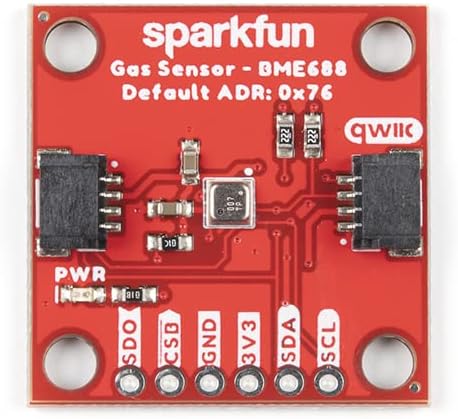
1-сүрөт: жогорудан ылдыйга view of the SparkFun BME688 Qwiic sensor board, showing the BME688 chip, Qwiic connectors, and labeled pins for power (PWR), data (SDO, SDA, SCL), ground (GND), and voltage (3V3).

2-сүрөт: Төмөнкү view of the SparkFun BME688 Qwiic sensor board, illustrating the I2C address selection jumpers (ADR) and SPI pins (SCK, SDI, SDO, CSB).

Figure 3: Size comparison of the SparkFun BME688 Qwiic sensor board with a US quarter, highlighting its compact form factor.
4. Орнотуу
4.1. Connecting via Qwiic
The Qwiic system simplifies connection. Use a Qwiic cable to connect the BME688 sensor to any Qwiic-enabled microcontroller or development board. This method requires no soldering. The default I2C address is 0x76.
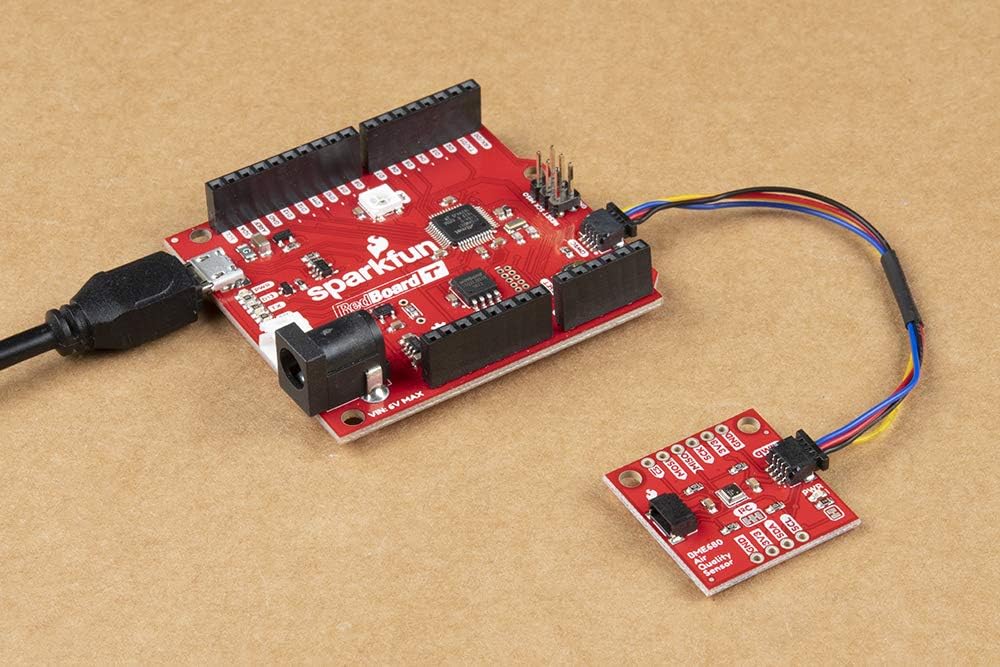
Figure 4: The SparkFun BME688 Qwiic sensor connected to a SparkFun RedBoard using a Qwiic cable, demonstrating a typical setup.
4.2. Connecting via Standard Pins (I2C/SPI)
For custom setups or if Qwiic is not preferred, the sensor can be connected using the standard 0.1-inch spaced pins.
- I2C байланышы: Connect SDA, SCL, 3V3, and GND pins. The I2C address can be changed from 0x76 to 0x77 by modifying the ADR jumper on the bottom of the board.
- SPI Communication: Connect SCK, SDI, SDO, CSB, 3V3, and GND pins.
4.3. Программалык камсыздоону орнотуу
To interface with the BME688, utilize compatible libraries such as the BSEC2 Arduino library. For advanced AI functionality and ease of use, it is recommended to consider the BME688 Evaluation Board, which is designed for use with the BME AI-Studio.
5. Иштөө нускамалары
5.1. Initializing the Sensor
After connecting the sensor, initialize it using the appropriate software library. This typically involves calling an initialization function that configures the sensor's operating mode and measurement parameters.
5.2. Reading Environmental Data
The BME688 can provide readings for temperature, humidity, and barometric pressure. Access these values through the library functions.
- Температура: Measured in degrees Celsius (°C).
- Нымдуулук: Measured as relative humidity (RH%).
- басым: Measured in hectopascals (hPa).
5.3. Gas Sensing and Interpretation
The gas sensor component requires a burn-in period upon initial power-up to stabilize readings. Gas readings are typically provided as an Indoor Air Quality (IAQ) index or raw resistance values, which can be correlated to gas concentrations (e.g., VOCs, VSCs) after calibration. Specific gas detection and quantification often require advanced algorithms and calibration against known gas sources. The sensor's standard gas scan speed is approximately 10.8 seconds per scan.
6. Техникалык шарттар
| Параметр | Нарк |
|---|---|
| Модель номери | SEN-19096 |
| Интерфейс | I2C (Qwiic), SPI |
| I2C даректери | 0x76 (Default), 0x77 (Selectable) |
| Operating Voltage | 1.71V - 3.6V (typically 3.3V) |
| Current Consumption (Active) | 2.1 мкАдан 18 мАга чейин |
| Current Consumption (Sleep) | 0.15 мкА |
| Температура диапазону | -40°Cден +85°Cге чейин |
| Температуранын тактыгы | ±1.0°C |
| нымдуулук колому | 0% - 100% RH |
| Нымдуулуктун тактыгы | ±3% RH |
| басым диапазону | 300hPa - 1100hPa |
| Басым тактыгы | ±60Pa (0°C to 65°C) |
| Gas Scan Speed | 10.8 sec/scan (standard) |
| Өлчөмдөр | 1.14 x 1.1 x 0.2 дюйм |
| Салмагы | 0.352 унция (0.01 килограмм) |
| Материал | Металл |

Figure 5: Dimensional drawing of the SparkFun BME688 Qwiic sensor board, showing precise measurements in inches for integration planning.
7. Техникалык тейлөө
The SparkFun BME688 sensor requires minimal maintenance.
- Колдонуу: Always handle the sensor by its edges or the PCB, avoiding direct contact with the metallic casing of the BME688 chip to prevent contamination that could affect gas sensing accuracy.
- Тазалоо: If necessary, gently clean the board with a soft, dry brush or compressed air. Do not use liquids or abrasive materials.
- Сактагыч: Store the sensor in a dry, non-condensing environment, away from extreme temperatures and corrosive gases.
8. Кыйынчылыктарды
- Сенсор аныкталган жок:
- Verify power connections (3V3 and GND).
- Check I2C/SPI wiring for correct pin assignments.
- Ensure the correct I2C address (0x76 or 0x77) is being used in your code, matching the jumper setting on the board.
- Confirm the Qwiic cable is securely connected if using the Qwiic interface.
- Inaccurate Gas Readings:
- Ensure the sensor has completed its initial burn-in period (typically several minutes to hours, depending on the environment).
- Avoid touching the metallic casing of the sensor, as oils and contaminants can affect gas sensing.
- Gas sensors require calibration for specific gases and environments to provide absolute accuracy. Without a controlled lab environment, absolute accuracy may be challenging to achieve, but readings should be repeatable.
- Environmental factors like humidity and temperature can influence gas sensor performance; ensure these are accounted for in your algorithms.
- Туруксуз окуулар:
- Check for stable power supply. Fluctuations can affect sensor performance.
- Ensure the sensor is not exposed to rapid changes in temperature or humidity, which can cause temporary fluctuations.
- Review your code for proper sensor reading intervals and data averaging.
9. Кепилдик жана колдоо
For warranty information and technical support, please refer to the official SparkFun Electronics website or contact their customer service directly. Detailed documentation, tutorials, and community forums are often available to assist with project development and troubleshooting.
Visit the SparkFun Store on Amazon көбүрөөк өнүмдөр жана маалымат үчүн.


